
Outdated or Unsupported Browser Detected
DWD's website uses the latest technology. This makes our site faster and easier to use across all devices. Unfortunatley, your browser is out of date and is not supported. An update is not required, but it is strongly recommended to improve your browsing experience. To update Internet Explorer to Microsoft Edge visit their website.

Questions? Contact us at HEARTGrant@dwd.wisconsin.gov
Use company name only in subject line for message delivery.
The Workforce Innovation Grant: Healthcare Employment, Access, & Rural Transformation (WIG: HEART) grant program will fund competitive grants for innovative projects that develop transformational solutions to workforce challenges impacting the quality and availability of health care in rural regions and communities across Wisconsin.
Through this initiative, the Wisconsin Department of Workforce Development (DWD) will expand on the success of Governor Evers’ $128 million Workforce Solutions Initiative grant program called the Workforce Innovation Grant (WIG) program. The WIG: HEART grant program will administer competitive, innovative grants for regions and communities to develop transformational solutions to workforce challenges impacting the quality and availability of healthcare in rural areas of Wisconsin.
This program aims to address the key health care workforce challenges facing rural areas of Wisconsin by funding projects focused on the following categories:
(See Section 5 of the Grant Program Announcement for more details.)
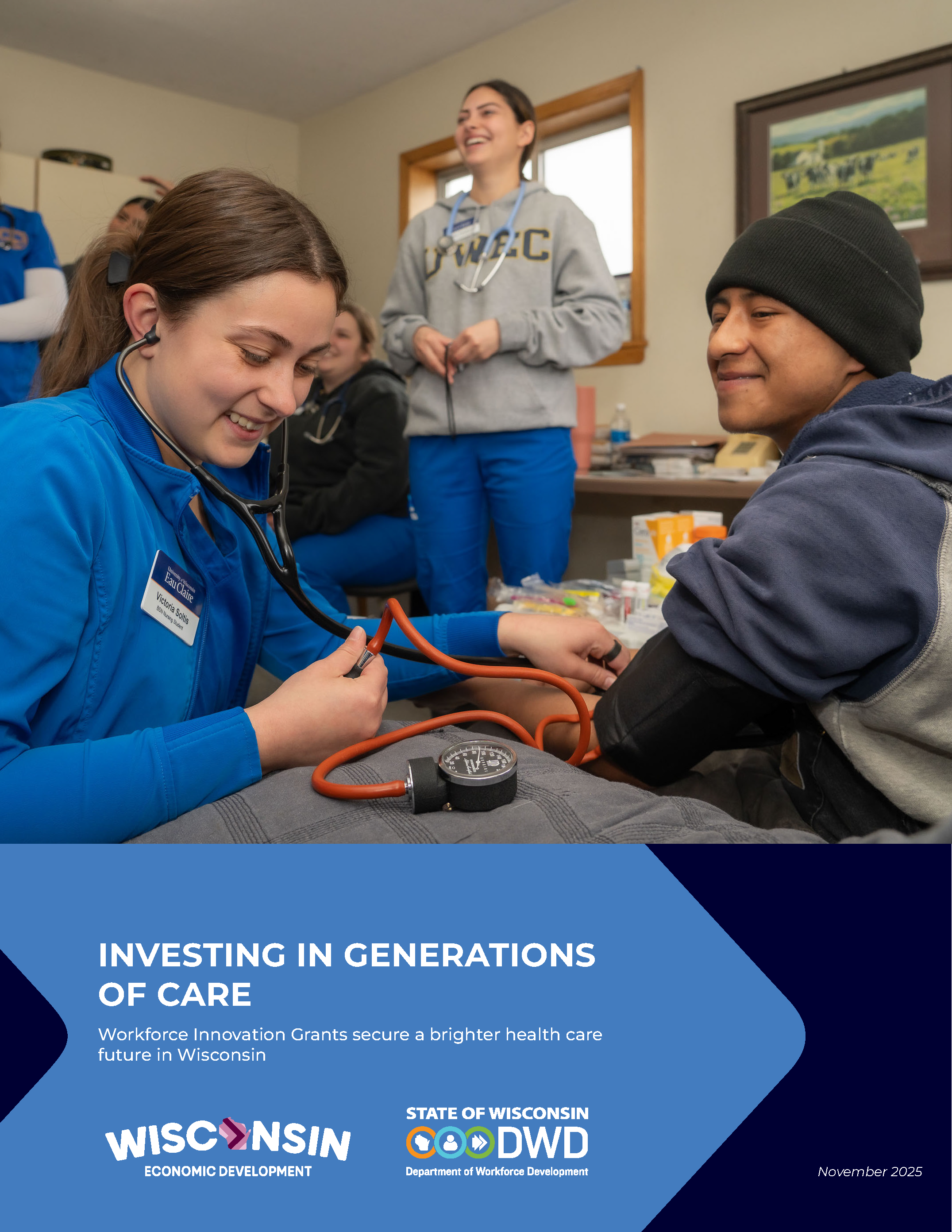
The Workforce Innovation Grant-funded projects featured in this report show examples of how communities built career pipelines to help ease the shortage of workers in healthcare fields. Projects like these provide examples of innovations that harnessed creativity and regional collaboration to tackle longtime local healthcare workforce needs and are good models for successful WIG: HEART projects.
Note that WIG: HEART grant eligibility requirements, allowable uses, award conditions, and other terms may differ from projects featured in this report. Carefully review all requirements in the Grant Program Announcement.
Eligible applicants may apply for awards at a minimum of $500,000 up to a maximum of $10 million across four years. For Year 1, approximately $4.9 million in total is available for Wisconsin grantees. Annual awards may vary, based on grant funding available and the grantees' performance and success in meeting expenditure milestones. When annual funding levels are made known to DWD, DWD will notify grantees and will work on any grant modifications that may be necessary based on available funding and grantees’ budgets and project plans. This grant program will fund four-year programs; applicants must reapply each year to access subsequent year funding amounts after review of project performance goals.
The 4-year program is scheduled to run from October 30, 2026, until September 1, 2030. The current application is for Year 1 of the grant and is anticipated to run from October 30, 2026 until September 1, 2027.
Eligible lead applicants must be 501(c)(3) nonprofit organizations and/or governmental entities located in and serving one of the counties in the target area map on page 3 of the Grant Program Announcement.
Additionally, applicants must conform to all the requirements outlined in Exhibit 5: Due Diligence Checklist and Pre-Award Risk Assessment.
Eligible lead applicants for these grant funds are 501(c)(3) nonprofit organizations and governmental entities located in and serving one of the counties listed in the target area map on page 3 of the Grant Program Announcement. Organizations and entities may apply as lead applicants on more than one application when representing multiple project partnerships. The cumulative award amount for a lead applicant is capped at $10 million regardless of the number of applications it is party to or submits. Organizations and entities may be identified as sub-recipients on more than one application when participating in multiple partnerships. Applications with supporting partners are strongly encouraged.
Eligible lead applicants for these grant funds are 501(c)(3) nonprofit organizations and governmental entities located in and serving one of the counties listed in the target area map on page 3 of the Grant Program Announcement. Other public organizations, private organizations, and/or nonprofit entities are encouraged to be included on the application as partners.
Quarterly and annual reports shall include qualitative progress updates on milestones and implementation, quantitative updates on metrics that the subawardee is tracking as a part of their workplan, quantitative description of funds expenditure by initiative and use of funds, and any additional information helpful to the Centers for Medicare & Medicaid Services (CMS). Reports shall identify any problems that arose and a statement explaining how the problem was resolved. Reports shall also identify any problems that have arisen but have not been completely resolved and provide an explanation. Potential data points include:
WIG: HEART is a reimbursement program. Organizations pay all costs upfront and then request reimbursement from the Wisconsin Department of Workforce Development (DWD). Advance payments of up to 5% can be issued in Year 1 award amounts for initial planning activities. Reimbursements will require submission of detailed implementation plans, comprehensive budgets, and measurable milestones. Release of remaining funds will be on a reimbursement basis contingent upon meeting performance milestones, allowable expenditures, and available funding.
Eligible and ineligible costs are outlined in the Grant Program Announcement.
All costs must be reasonable, necessary, and allocable to the project and in accordance with 2 CFR Part 200, Uniform Administrative Requirements, Cost Principles, and Audit Requirements for Federal Awards, with some modifications included in 2 CFR Part 300.
Activities may begin only after the grant agreement (contract) between the organization and DWD is fully executed. Costs incurred prior to contract execution are not eligible for reimbursement. The official start date will be established in the executed agreement.
The personnel grant management budget line is limited to 10% of the requested funds and the staff employed by the lead applicant. Personnel grant management expenses are those incurred for the general operation of the grant only, such as the time spent reporting on grant progress, entering trainee data, and managing grant financials.
The minor renovations budget line is limited to 20% of the total funding.
The WIG: HEART grant program supports the following activities:
(See Section 5 of the Grant Program Announcement for more details.)
Applications must be submitted by 3 p.m. Central Time, Aug. 17, 2026.
All applications must be submitted through the applicant portal on the Department of Workforce Development’s website: [Link to Application]
Applicants must submit all of the following documents. Incomplete applications will not be considered. If an applicant does not submit all of the following, the application will not be evaluated and scored:
Organizations and entities are required to apply their federally negotiated indirect cost rate to account for services such as human resources, information technology, and procurement. The rate supports the enterprise services required to operationalize a grant. For organizations and entities that do not have a federally negotiated rate, please use 15% as the de minimis rate allowed. This applies to Modified Total Direct Cost (MTDC) - all direct salaries and wages, applicable fringe benefits, materials and supplies, services, travel, and up to the first $50,000 of each subaward (regardless of the period of performance of the subawards under the award). MTDC excludes equipment, capital expenditures, charges for patient care, rental costs, tuition remission, scholarships and fellowships, participant support costs, and the portion of each subaward in excess of $50,000. Other items may only be excluded when necessary to avoid serious inequity in the distribution of indirect costs and with the approval of the cognizant agency for indirect costs.
Applications will be scored competitively by an independent evaluation committee consisting of one or more panels. Applications will be scored based solely on the information provided by the applicants. As a result, applicants should include all relevant information in their application materials that effectively communicates their proposed solution to the evaluation committee. Please review the grant rubric for specific scoring criteria.
A strong initiative is one that clearly describes the rural health care workforce challenge being addressed, lays out a practical and evidence-based solution, aligns with the applicant’s overall transformation plan, clearly explains how it can realistically be carried out with available resources on a stated timeline, has specific measurable outcomes, and demonstrates how improvements will last and can be sustained beyond the four-year award period.
Under the uses of funds described in statute, there is a minimum five-year commitment for clinical workforce talent to serve rural communities who benefit from recruiting and retention initiatives funded by the WIG: HEART grant program.
No. Funds used for workforce development must be used to “recruit and retain clinical workforce talent to rural areas for a minimum of 5 years.” Therefore, any clinicians recruited or retained under this use of funds must be physically located in rural areas.
WIG: HEART funding is designed to support expansion and scale to better serve rural communities, not to replace or duplicate existing funding sources. When an organization uses WIG: HEART funds to expand an existing pilot program or initiative or to develop new training programs with existing partners, the funds may only be applied to the costs associated with the new population, new activities, new program milestones, etc. The original program's programmatic costs, administrative expenses, and activities—those already funded by the organizations and/or existing partnerships—must continue to be funded by those original sources.
Yes. The WIG: HEART grant program is a Wisconsin-specific program. All initiatives should address the needs and goals of Wisconsin’s rural communities outlined in the applicant’s Project Narrative. Therefore, clinicians benefitting from recruitment and retention initiatives must practice within Wisconsin.
All uses of funds aiming to recruit and retain clinical workforce to rural areas require a five-year commitment from the individual to practice in rural areas. This includes financial recruitment and retention incentives.
If a program offers a structured, certifiable pathway to a new degree, new certification, or to a career/new job opportunity in the clinical workforce in a rural area, the 5-year service requirement will apply.
NOTE: Please see CMS’s guidelines for more information on the five-year service requirement. https://www.cms.gov/files/document/5-year-service-commitment-fact-sheet.pdf
Capital expenditures are expenditures to acquire capital assets or expenditures to make additions, improvements, modifications replacements, rearrangements, reinstallations, renovations, or alterations to capital assets that materially increase their value or useful life. New construction is unallowable for this grant program. Please refer to 2 CFR 200.439 for additional information.
Funding for local housing for students or trainees in rural areas may be allowable if included as part of an approved initiative within the scope of the WIG: HEART grant program. Note that payment for student or trainee housing is limited to short-term (less than 6 months) housing for rotations.
Questions about the WIG: HEART grant program can be directed to HEARTGrant@dwd.wisconsin.gov. Use applicant or organization name only in subject line for message delivery.
DWD will provide technical assistance through informational webinars, guidance materials, or direct consultation during the application period. Organizations are also encouraged to contact their local Workforce Development Board for assistance.
The Workforce Innovation Grant: Healthcare Employment, Access, and Rural Transformation (WIG: HEART) grant program project is supported by the Centers for Medicare & Medicaid Services (CMS) of the U.S. Department of Health and Human Services (HHS) through a subaward as part of a financial assistance award made to the State of Wisconsin Department of Health Services totaling $203,670,005.21 with 100 percent funded by CMS/HHS. The contents are those of the author(s) and do not necessarily represent the official views of, nor an endorsement, by CMS/HHS, or the U.S. Government.
WIG: HEART Grant Program Announcement


Exhibit 2: Budget - Years 2 to 4
Exhibit 5: Due Diligence Checklist and Pre-Award Risk Assessment
Successful WIG Healthcare Awards
HEARTGrant@dwd.wisconsin.gov
Use applicant or organization name only in subject line for message delivery.
201 E. Washington Ave.
PO Box 7972
Madison, WI 53703
DWD Contact Information
201 E. Washington Ave
P.O. Box 7946
Madison, WI 53707
(608) 266-3131
Sign up for DWD news and updates


A proud partner of the  network